

In a world that never sleeps, the traditional “wait and see” approach to business safety is rapidly becoming a relic of the past. For decades, risk management was primarily defensive. A reactive shield raised only after an attack had begun or a disaster had struck. However, in today’s hyper-connected landscape, waiting for a red flag is often waiting too long. This is why forward-thinking leaders are undergoing a smart strategic evolution: the shift to AI-driven risk management.
This transition moves organizations from reactive controls to predictive safeguards, using the power of data not just to clean up messes, but to prevent them entirely. It is a transformation that promises to keep businesses safe, resilient, and ready for whatever the future holds.
The Shift: From Reaction to Prediction
Historically, risk managers were like essential, brave firefighters, but usually called upon only when there was smoke. This reactive stance meant that damage control was the primary mode of operation. AI-driven risk management flips this script. It functions more like a sophisticated weather satellite, scanning the horizon to predict the storm long before the clouds gather.
The business world is waking up to this necessity. The market for AI-driven risk management is expanding at an impressive rate. Research projects that the global AI model risk management market will grow from $5.5 billion in 2023 to $12.6 billion by 2030. This represents a compound annual growth rate (CAGR) of 12.8%, a statistic that underscores a universal truth: in the digital age, prediction is the ultimate form of protection (Grand View Research).

By leveraging Artificial Intelligence (AI) and Machine Learning (ML), organizations can analyze vast oceans of data to identify subtle patterns that precede a crisis. This capability allows for proactive risk mitigation, enabling companies to neutralize threats before they impact the bottom line.
3 Strategies: How AI Security Intelligence Transforms Operations
The engine behind this transformation is data. AI-driven risk management systems ingest data from a multitude of sources (transaction logs, market trends, geolocation data, and even social media sentiment) to build a dynamic picture of an organization’s risk profile. Here is how this technology is being applied across three critical domains.
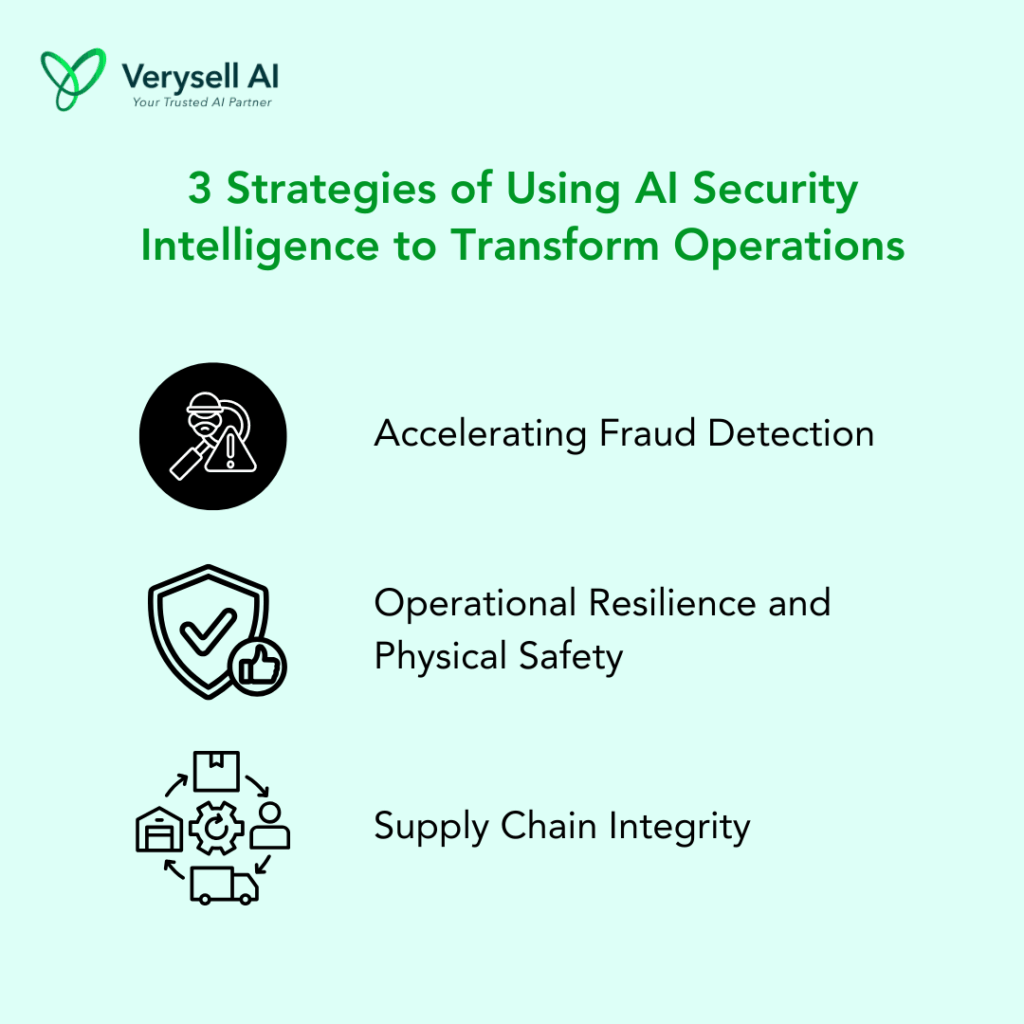
1. Accelerating Fraud Detection
One of the most immediate and high-impact applications of AI security intelligence is in the fight against financial crime. Traditional rule-based systems are often rigid; they struggle with false positives and fail to catch novel fraud patterns that haven’t been programmed into them. In contrast, AI models are fluid learners.
AI-powered tools can identify “shadow data” and monitor abnormalities in user access, alerting cybersecurity professionals to potential insider threats or external breaches instantly. The efficiency gains are measurable and significant. By automating these response protocols, organizations can accelerate alert investigations by an average of 55% (IBM). This speed is crucial when every second of a breach can cost millions in lost data and trust.
2. Operational Resilience and Physical Safety
Predictive safeguards extend beyond digital firewalls to protect physical assets and human lives. The industrial sector provides a compelling case study on the tangible benefits of AI.
In the U.S. mining sector, researchers have developed predictive models that analyze historical accident data to forecast future incidents. These systems have achieved 70-76% accuracy in predicting accidents (Ajibose et al., 2025). Even more impressively, these systems can detect risks up to 48 hours in advance. The potential human impact is profound: the implementation of such predictive safeguards could reduce machinery-related fatalities by 24%. This demonstrates that AI-driven risk management is not just about saving money; it is about saving lives.
3. Supply Chain Integrity
Retailers and logistics companies are also leveraging AI security intelligence to fight organized retail crime. By integrating data from point-of-sale systems, e-commerce platforms, and logistics, AI can link seemingly unrelated refund claims or inventory losses to a single fraudulent network. This unified view turns fragmented data into a defensive shield, preventing losses before they cascade through the supply chain.
Real-World Success: The Numbers Don’t Lie
The theoretical benefits of AI-driven risk management are powerful, but the practical results from major global players paint an even clearer picture of success.
- Mastercard: As a global payments giant, Mastercard faces a deluge of data. Utilizing its “Decision Intelligence” system, the company analyzes over 160 billion transactions annually. The speed of this AI-driven risk management is staggering: the system can detect fraudulent activity within just 50 milliseconds. This capability boosts detection rates while simultaneously reducing the annoyance of false positives for legitimate customers.
- Citibank: The banking sector relies heavily on stress testing to ensure stability. By implementing AI-powered Monte Carlo stress testing, Citibank successfully reduced its operational losses by 35%. The system improved their forecasting accuracy, providing real-time insights into risk exposure that traditional methods simply could not match.
- Network International: This payment solutions provider serves the Middle East and Africa, a region seeing a massive surge in digital transactions. To handle the scale, they transitioned from a rules-based system to an AI-driven one. This shift allowed them to predict fraud trends rather than merely reacting to them, ensuring scalable security for clients across multiple countries.
These examples illustrate that proactive risk mitigation is a measurable competitive advantage that safeguards reputation and revenue.
Navigating the Challenges of AI Adoption
While the promise of AI-driven risk management is immense, the path to implementation is paved with challenges that require careful navigation.
The “Black Box” Problem
A significant hurdle is the lack of transparency, often referred to as the “black box” problem. Complex deep learning models can produce highly accurate risk scores without offering a clear explanation of how they arrived at that decision. In risk management, where auditability and regulatory compliance are key, this can be a major liability. To counter this, there is a growing trend toward “Explainable AI” (XAI), which aims to make AI decisions transparent and understandable for human stakeholders.
Data Bias and Privacy
AI-driven risk management models are only as good as the data they are fed. If training data is biased, the system’s risk assessments will be flawed, potentially leading to discriminatory outcomes in lending or hiring. Furthermore, the reliance on vast amounts of personal data raises significant privacy concerns. Unauthorized access to these datasets can lead to severe regulatory penalties under laws like GDPR. Robust governance frameworks are essential to ensure that predictive safeguards remain ethical and compliant.
The Road to 2025: What Lies Ahead?
As we look toward 2025, the role of AI in risk will only deepen. We are moving toward a future of “AI Agents”, autonomous systems capable of planning and executing workflows to mitigate risk without human intervention.
One of the most significant trends is the automation of compliance. By 2025, it is estimated that more than half of major enterprises will rely on AI for continuous regulatory compliance monitoring (Serhii Uspenskyi, 2025). This shift will free up human risk managers to focus on high-level strategy rather than box-checking.
Furthermore, we will see the rise of converged security. The boundaries between physical and cyber security will continue to blur. AI platforms will increasingly integrate data from both realms, eg. linking a physical door access log with a digital network login, to create a unified security posture.
Conclusion
The transition to AI-driven risk management represents a fundamental maturity in how organizations view stability and growth. By adopting predictive safeguards, businesses are effectively buying themselves time: time to react, time to adapt, and time to prevent disasters before they occur.
While challenges in transparency and bias remain, the trajectory is clear: the future belongs to those who can predict it. Embracing this smart technology today is the surest way to build a safe and resilient tomorrow.
Ready to Build Your Predictive Safeguards?
At Verysell AI, we don’t just talk about the future; we build it. Our team of excellent engineers specializes in delivering bespoke AI solutions and conversational AI chatbots that can transform your risk management strategy from reactive to predictive. Whether you need to secure your data or streamline your operations, we have the expertise to make it happen.
Contact Verysell AI today to discuss how we can engineer a safer, smarter future for your business.