

Enterprise AI has moved beyond experimentation. Organizations are now under pressure to deliver measurable value from artificial intelligence while managing cost, risk, speed, and long-term scalability. The central architectural question is no longer whether to adopt AI, but how to do so sustainably. At the core of this decision lies a strategic choice between three approaches: Build, Buy, or Compose. Each path reflects a different philosophy of control, investment, and time to value.
>> Click here to read our blog post related to comprehensive self-assessment!
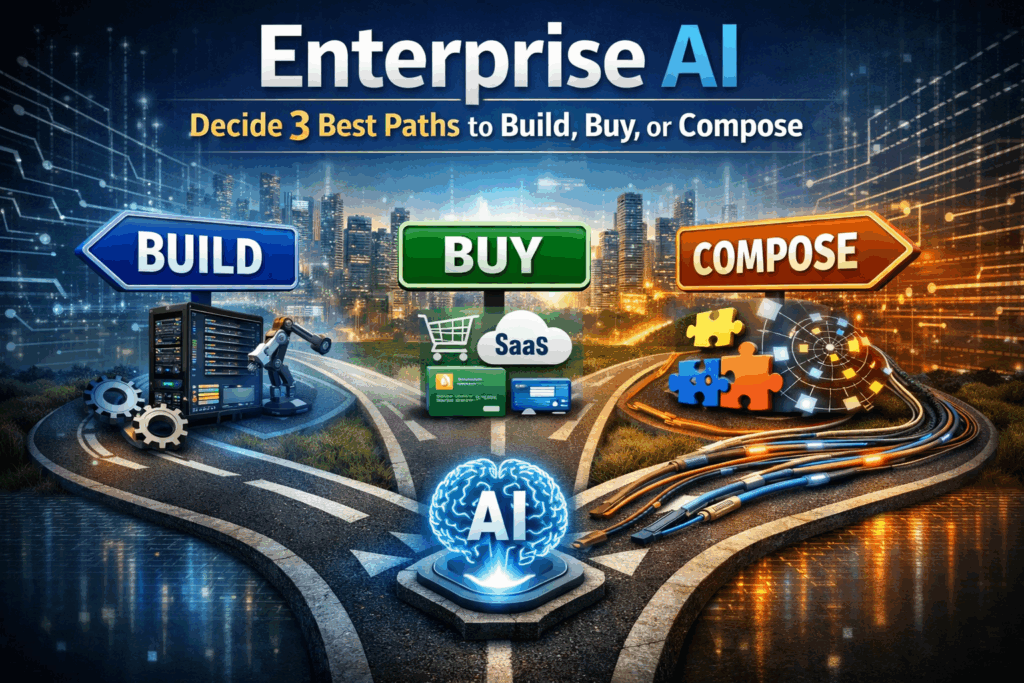
Choosing incorrectly can lead to technical debt, stalled adoption, or wasted capital. Choosing wisely can accelerate competitive advantage. This article examines the three approaches in depth, clarifies when each makes sense, and provides a structured way to evaluate them in an enterprise context.
1. Enterprise AI Era 101
Enterprise AI represents the systematic application of artificial intelligence across core business functions to improve decision quality, operational efficiency, and strategic agility at scale. Unlike isolated AI pilots, Enterprise AI requires production-grade architecture, governed data flows, integration with legacy systems, and clear ownership across business and technology teams. Its success depends not only on model performance, but on how well AI is embedded into real workflows, aligned with business outcomes, and managed over time through robust governance, security, and change management.
2. Build: Full Ownership, Maximum Control
Building Enterprise AI in-house means designing and developing models, data pipelines, infrastructure, and application logic from the ground up, with the organization retaining full ownership of the entire lifecycle from data preparation and training to deployment, monitoring, and continuous optimization. This approach is best suited to core AI capabilities that define competitive differentiation, highly regulated or sensitive environments where strict data control is mandatory, and organizations with mature data foundations, strong internal AI talent, and established MLOps practices.
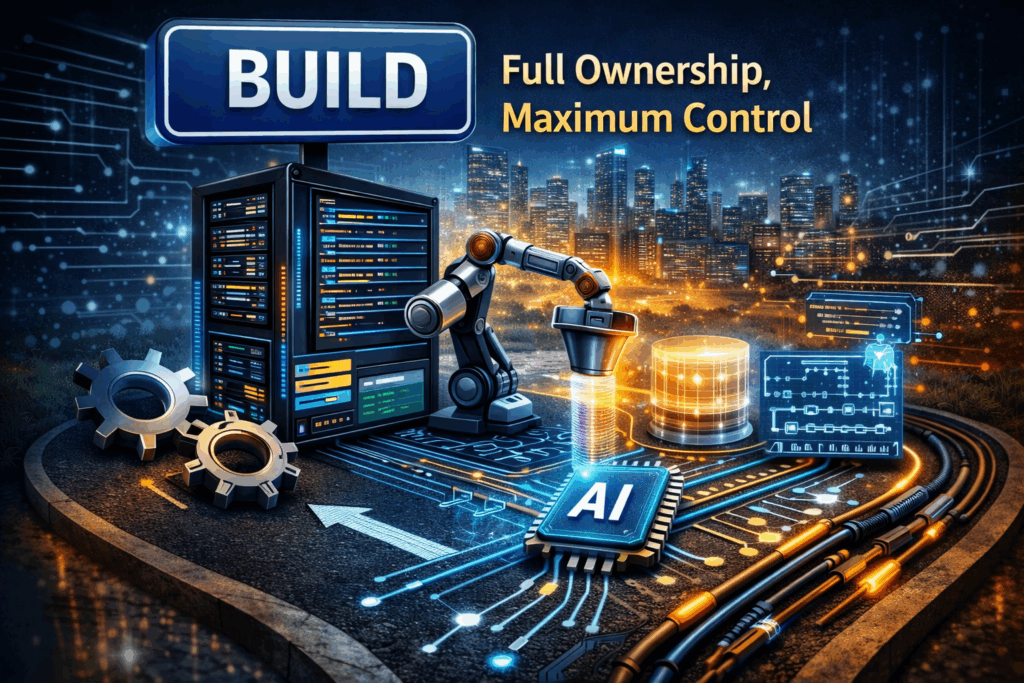
The primary advantage of this path lies in deep customization aligned with business-specific processes, strong control over security and compliance, and the freedom to innovate without vendor constraints. However, it requires significant upfront investment, longer time to production, and sustained operational effort as models, data, and tools evolve. A common risk is underestimating the complexity of operating production-grade AI systems, particularly the ongoing demands of monitoring, retraining, governance, and reliability at scale.
3. Buy: Speed and Predictability
Buying Enterprise AI involves adopting third-party AI products, platforms, or SaaS solutions that deliver prebuilt capabilities such as chatbots, fraud detection, recommendation engines, or analytics. This approach works best for standardized use cases with well-established best practices, functions that support rather than differentiate the business, and organizations that prioritize rapid deployment, predictable costs, and reduced technical complexity.

The key benefits include faster time to value, lower upfront investment, and vendor-managed updates, security, and performance. However, these advantages come with trade-offs, including limited customization, potential vendor lock-in, and possible misalignment with unique internal workflows. A common risk is adopting tools that address only surface-level needs but fail to integrate deeply with core systems, resulting in fragmented user experiences and constrained long-term impact.
4. Compose: Strategic Modularity
Composing Enterprise AI involves combining prebuilt components such as foundation models, APIs, and industry accelerators with custom logic, orchestration layers, and domain-specific data. This approach is neither fully bespoke nor fully off-the-shelf, making it well suited to complex enterprises that need to balance speed with differentiation, organizations with partial AI maturity, and use cases that are expected to evolve over time.
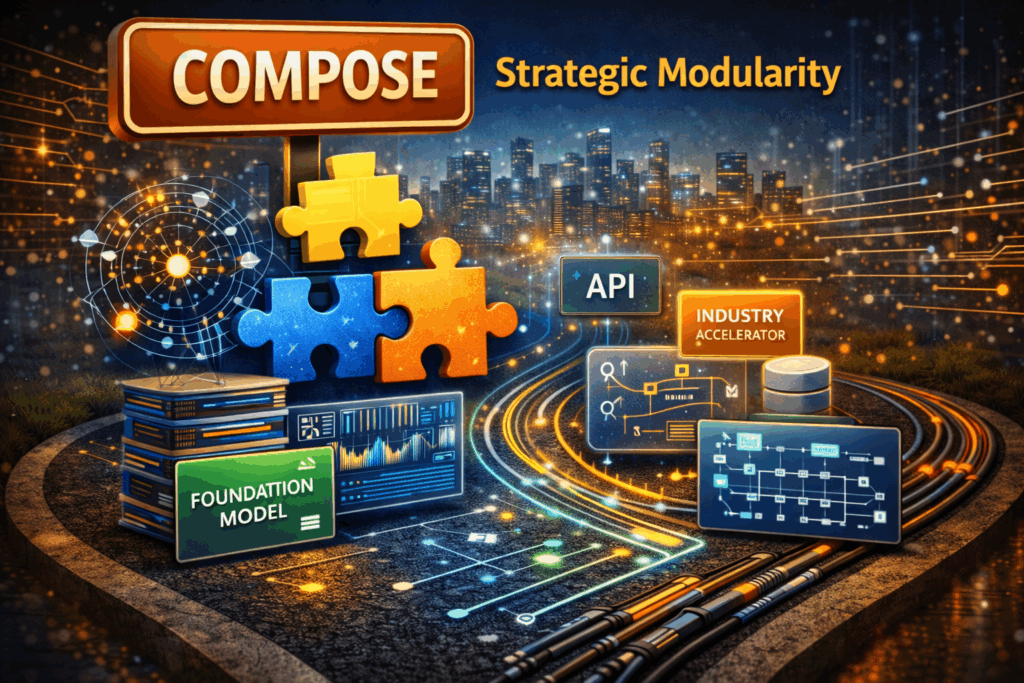
The main advantages include faster delivery compared to a full build, greater flexibility than buying packaged solutions, and a modular architecture that can scale and adapt as requirements change. It also enables a clear separation between commodity AI capabilities and proprietary business logic. However, this approach demands strong architectural discipline and integration expertise, and governance can become more complex across multiple components. A common risk is that, without clear standards and ownership, composed systems may become fragmented or inconsistent over time.
5. How Enterprises Should Decide
The right Enterprise AI strategy is rarely ideological. It is contextual. Decision-makers should evaluate:
- Business criticality: Is this capability core to competitive advantage or operational support?
- Data maturity: Do you have reliable, governed, and accessible data?
- Talent readiness: Can you build and sustain AI systems long term?
- Speed requirements: Is time to market a decisive factor?
- Regulatory exposure: How sensitive is the data and decision logic?
In practice, most mature organizations converge toward a portfolio approach, using all three strategies across different use cases.
Conclusion
Enterprise AI is not a single technology decision but an architectural strategy. Building offers control, buying offers speed, and composing offers balance. The most resilient enterprises are those that treat these options as complementary tools rather than mutually exclusive choices. The real advantage lies not in choosing one path, but in knowing when and why to apply each.
In practice, this requires enterprises to think in portfolios rather than absolutes, deliberately aligning each AI initiative with its strategic importance, risk profile, and expected lifespan. Foundational capabilities that underpin long-term differentiation may justify a build approach, standardized or transient needs may be best served by buying, while evolving, cross-functional use cases often benefit most from composition. Enterprises that establish clear architectural principles, governance models, and decision criteria for these choices are better positioned to scale AI responsibly and sustain value over time.
