

Manufacturing AI Exposed is not a critique of artificial intelligence itself, but a sober examination of the points where automation consistently underperforms expectations. Over the past decade, manufacturers have invested heavily in AI-driven systems to improve efficiency, reduce costs, and stabilize quality. While these systems deliver clear value in controlled environments, real-world manufacturing exposes structural limits that technology alone cannot overcome.
Understanding where automation breaks down is essential for leaders who want sustainable, scalable AI adoption rather than isolated pilot successes. In the blog post, we will explore five points where automation fails in the manufacturing AI exposed.
>> Explore the blog post about manufacturing industry with 5 AI powerful ways!
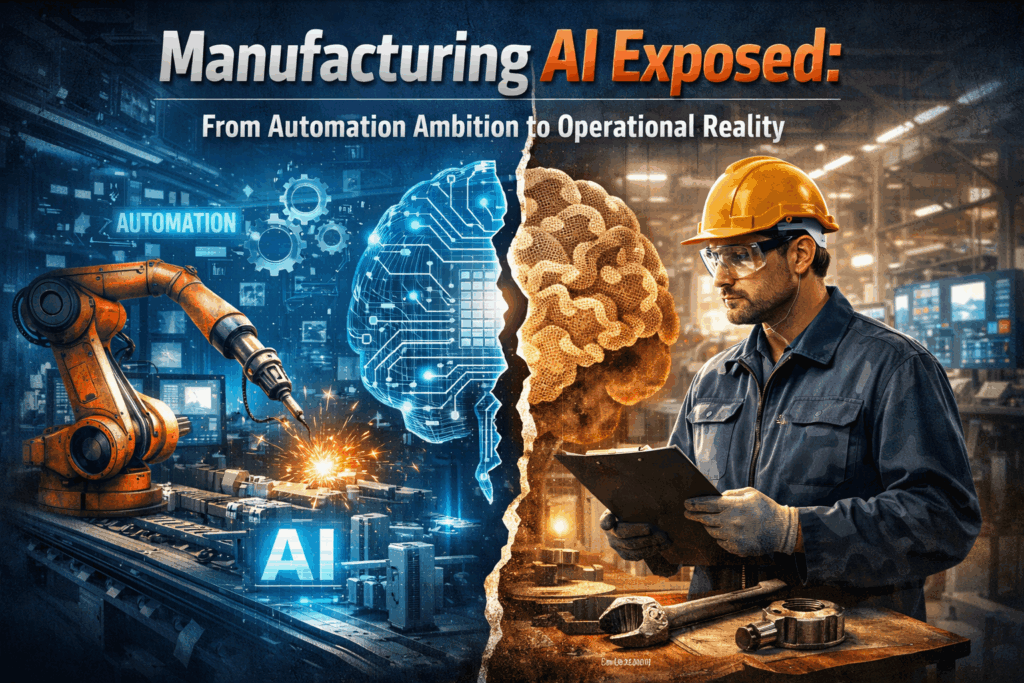
1. Manufacturing AI Exposed: From Automation Ambition to Operational Reality
Manufacturing AI Exposed underscores a critical shift that manufacturing leaders must make: moving from technology-first ambition to operations-first design. AI succeeds not when it is deployed broadly, but when it is applied precisely to problems that are well-bounded, measurable, and owned by the business. This requires reframing AI initiatives as continuous operational programs, not innovation showcases. When success is defined by reduced variability, faster recovery from disruption, and better human decision-making on the factory floor, manufacturing AI exposed becomes a stabilizing force rather than a fragile layer of automation.
To achieve this operational-first mindset, manufacturing leaders must foster a culture of collaboration and continuous improvement among their teams. Emphasizing cross-functional engagement ensures that insights from various stakeholders, ranging from production line workers to data analysts are integrated into manufacturing AI exposed deployment strategies. This holistic approach not only enriches the problem-solving process but also empowers employees, enhancing their ability to leverage AI tools effectively.
By prioritizing practical applications of manufacturing AI exposed that tackle specific operational challenges, organizations can cultivate resilience, ultimately leading to improved productivity and a more agile response to market fluctuations. Transforming AI into a core operational asset positions manufacturing firms to thrive in an increasingly competitive landscape.
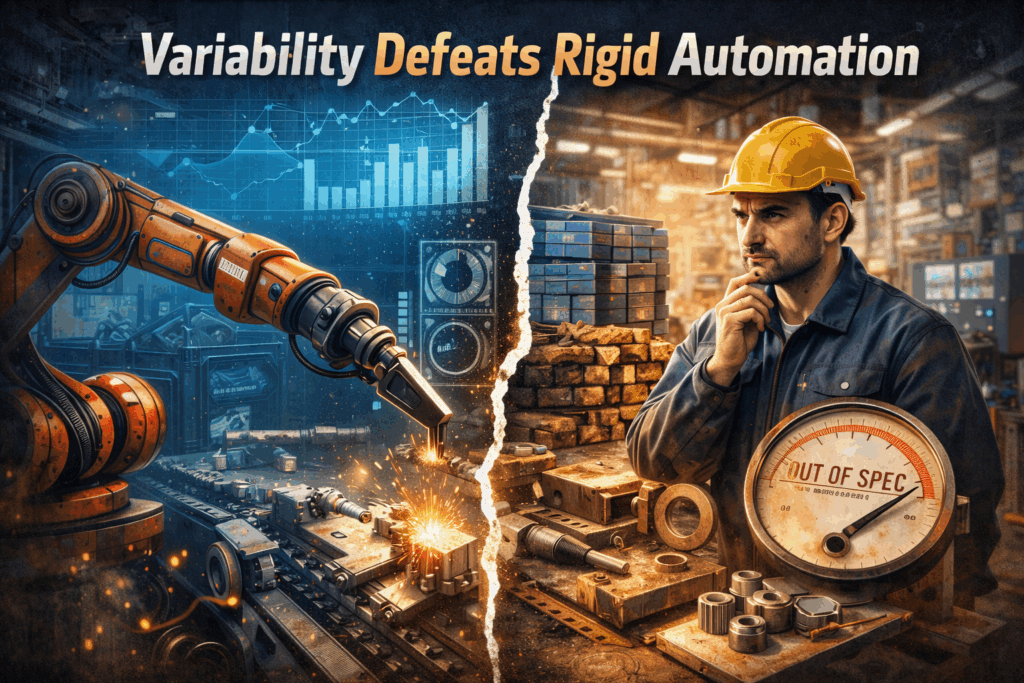
2. Variability Defeats Rigid Automation
Manufacturing environments are inherently variable. Raw material quality fluctuates, machines age unevenly, and human interventions differ shift by shift. Traditional automation and even advanced AI models perform best when inputs remain within a narrow, predictable range. When conditions drift beyond trained scenarios, AI systems often degrade silently. Instead of failing fast, they produce plausible but incorrect outputs. This creates operational risk because errors propagate before being detected. In contrast, experienced operators adapt intuitively to subtle changes. AI systems require explicit retraining, data revalidation, and governance to regain accuracy, which introduces latency that many factories underestimate.
To effectively navigate this complexity, manufacturers must implement robust monitoring frameworks that continuously assess both the operational environment and the performance of manufacturing AI exposed. By integrating real-time data analytics and feedback mechanisms, organizations can swiftly identify deviations and assess their impact on AI outputs. This proactive stance not only mitigates the risks associated with silent degradation but also enables a more agile adaptation to changing conditions.
Furthermore, fostering a partnership between human operators and manufacturing AI exposed can enhance decision-making processes, as operators can provide contextual insights that inform AI retraining efforts. By cultivating a symbiotic relationship between technology and human expertise, manufacturers can ensure that AI evolves alongside their dynamic environments, maintaining operational efficiency and reducing the likelihood of costly disruptions.
3. Data Quality Remains the Primary Bottleneck
Manufacturing AI exposed is only as reliable as the data feeding it. In practice, production data is fragmented across legacy machines, inconsistent sensors, manual logs, and disconnected IT systems.
Common challenges in manufacturing AI exposed implementation often stem from data-related issues that hinder effective decision-making. Missing or delayed data from shop-floor equipment can result in incomplete insights, making it difficult to identify real-time performance issues. Similarly, inconsistent labeling in quality inspection datasets complicates the training of manufacturing AI exposed models, leading to unreliable outputs. These data inconsistencies not only affect the accuracy of predictions but also diminish the overall trust in AI systems among operators and management.
Moreover, relying on historical data that reflects outdated processes can exacerbate these challenges. As manufacturing environments evolve, so too must the data that informs AI models. When organizations fail to update their datasets to align with current realities, they risk deploying AI solutions that are out of sync with operational needs. This disconnect can create significant gaps in performance and responsiveness, ultimately resulting in product quality issues, increased waste, and customer dissatisfaction. To overcome these challenges, manufacturers must prioritize robust data management practices that ensure accuracy, consistency, and relevance across their AI initiatives.
AI models trained on such data may show strong lab performance but fail in production. This gap is not a modeling problem; it is a data architecture and governance problem. Without disciplined data standards, AI becomes an amplifier of existing operational noise rather than a source of clarity.
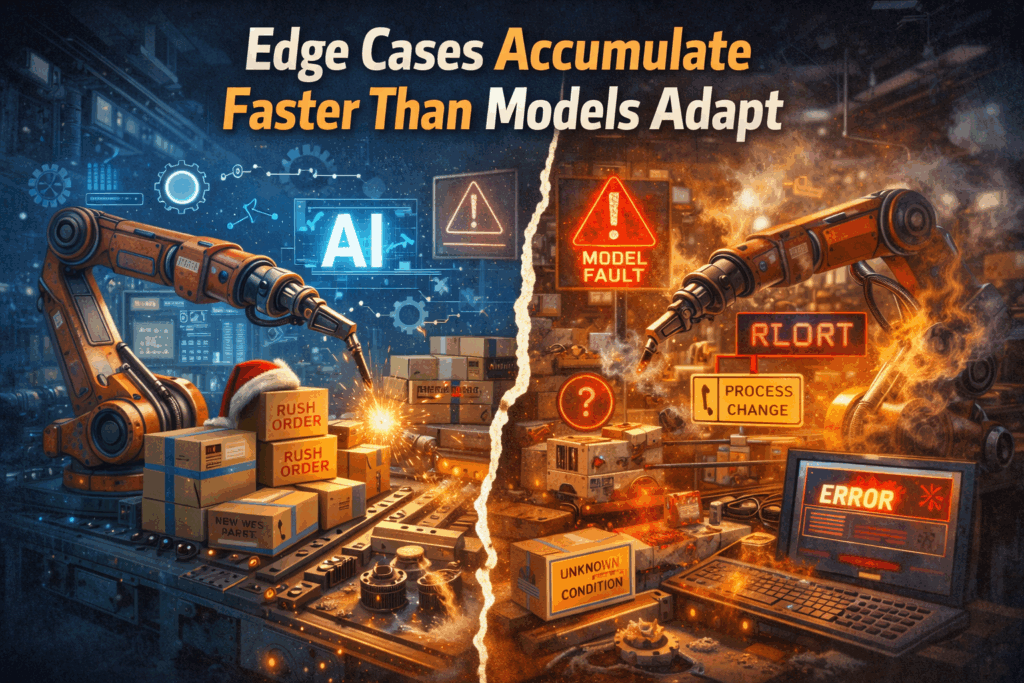
4. Edge Cases Accumulate Faster Than Models Adapt
Manufacturing AI exposed processes generate edge cases continuously. New suppliers, custom orders, small batch runs, and emergency process changes introduce conditions that models have never seen. While retraining is technically feasible, it is rarely operationally trivial. Each update requires validation, downtime planning, and coordination between IT, engineering, and operations. As a result, factories often run AI models that are partially obsolete. Performance degrades gradually, creating a false sense of stability until failure becomes visible through scrap, rework, or customer complaints.
To address these challenges, manufacturers need to adopt a more agile and responsive approach to AI management for their edge cases. Implementing a continuous improvement cycle that includes regular audits and updates of AI models can help maintain their relevance in dynamic production environments. This cycle should involve not only data scientists but also frontline workers who can provide invaluable insights on emerging edge cases and operational challenges.
By leveraging an iterative testing framework, organizations can ensure that AI systems with egde cases are adaptable, allowing for swift adjustments in response to new parameters without extensive downtime. Additionally, fostering a culture of collaboration across departments can streamline communication and enhance the overall understanding of AI’s role in manufacturing, ultimately leading to more reliable performance and a greater ability to meet customer demands without compromising quality.
5. Human-AI Collaboration Is Poorly Designed
Many AI initiatives assume replacement rather than augmentation. Systems are deployed to remove human judgment instead of supporting it. This creates two problems. First, operators lose trust when Manufacturing AI Exposed decisions cannot be explained or overridden. Second, organizations fail to capture tacit human knowledge that could improve model performance.
Effective manufacturing AI exposed should be designed as a decision-support layer from highlighting anomalies rather than enforcing decisions, explaining confidence levels and uncertainty and learning from operator corrections in structured ways. Where collaboration is absent, automation becomes brittle.
6. Organizational Readiness Lags Behind Technology
Even when AI models perform well, organizational factors frequently limit impact. These include unclear ownership between IT and operations, misaligned KPIs, and lack of accountability for AI outcomes after deployment. Manufacturing AI is not a one-time implementation. It is a living system that requires ongoing monitoring, retraining, and process alignment. Organizations that treat AI as a capital expense rather than an operational capability struggle to sustain value.
Conclusion: Rethinking Success in Manufacturing AI
Manufacturing AI Exposed reveals a consistent pattern: automation breaks down not because AI is weak, but because manufacturing reality is complex, adaptive, and deeply human. The most resilient manufacturers are shifting their mindset from full automation to targeted augmentation, from model accuracy to system robustness and from pilot metrics to long-term operational resilience.
AI delivers its greatest value when it is embedded into processes, governed as a capability, and designed to work with human expertise rather than replace it. In manufacturing, the future is not autonomous factories. It is intelligent factories that know when automation should lead, and when humans must remain firmly in the loop.
At Verysell AI, we work with manufacturers to move beyond experimental automation and build AI systems that withstand real production complexity. Our approach focuses on operational readiness, human-in-the-loop design, and scalable architectures that evolve with changing processes, suppliers, and market demands. If your organization is reassessing how AI can deliver consistent value on the factory floor, we invite you to explore how a pragmatic, systems-level AI strategy can transform Manufacturing AI from a risk into a long-term competitive capability.
