

For over a century, the manufacturing world operated on a simple, powerful model: mass production. This paradigm, epitomized by Henry Ford’s “any color as long as it’s black,” gave us unprecedented efficiency and low-cost goods. That era is definitely over. Today’s consumers, raised on a diet of digital custom-fit experiences, no longer want what everyone else has. They demand products tailored to their unique needs and preferences, a trend known as mass customization.

This shift has placed the traditional, rigid manufacturing supply chain under almost unbearable pressure. A system built for volume and predictability is now being asked for flexibility and “lot sizes of one.” In fact, research from McKinsey reveals that 71% of consumers expect companies to deliver personalized interactions, and 76% get frustrated when this doesn’t happen. How can a factory built to make a million identical items suddenly produce a million unique items?
The answer lies in AI personalisation. This is not just a marketing buzzword; it is the core technology enabling a fundamental reinvention of how we source, build, and deliver goods. AI is not merely optimizing the old supply chain; it is forging an entirely new one, one that is intelligent, predictive, and built around the individual customer.
The “One-Size-Fits-All” Supply Chain is Broken
The traditional manufacturing supply chain is a linear, siloed system. It operates on a “push” model: long-range forecasts (often guesses) are made, raw materials are ordered in bulk, and products are manufactured in large batches. This model is notoriously inflexible. It is the cause of the “bullwhip effect,” where a small, unexpected change in customer demand (e.g., a 10% dip in sales) can create massive, chaotic disruptions upstream, leading to either vast overstocks or crippling shortages.
This rigid system simply cannot handle hyper-personalisation. It is slow, creates enormous waste, and locks capital into inventory that may never sell. To meet the demand for custom products, a new model is required. Instead of a “push” system, we need a “pull” system, one that can sense the specific needs of an individual customer and responsively orchestrate the entire production and delivery process around that single order.
This is precisely what AI personalisation does. In this context, it refers to using AI to anticipate the needs of a microsegment (or even a single customer) and automatically adjust the entire supply chain, from procurement to final-mile logistics, to meet that demand efficiently.
Here are the five powerful ways AI is making this revolution a reality.
1. From Guesswork to Precision: True Predictive Demand Forecasting
The most significant flaw in the old supply chain is its reliance on historical data for forecasting. This approach assumes the future will look exactly like the past, a dangerous assumption in today’s fast-moving market.
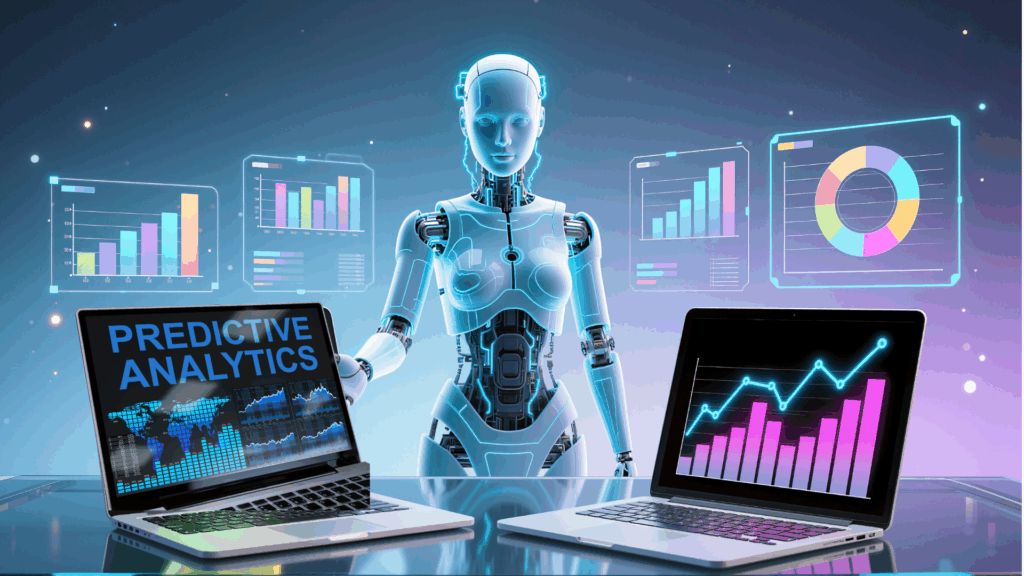
AI-powered predictive demand forecasting is a complete paradigm shift. Instead of just looking at last year’s sales, machine learning models analyze thousands of variables in real-time. These can include social media trends, competitor pricing, weather patterns, IoT sensor data, and even local event schedules. By identifying subtle patterns that no human team could ever detect, AI can predict demand for highly specific, personalized products.
The impact is transformative. A report from IBM highlights that AI-driven forecasting can reduce errors by up to 50%. This capability is why 91% of supply chain leaders plan to use AI for demand forecasting, according to ABI (2024). This newfound accuracy, a direct result of AI, is the foundational element that enables the rest of the personalized manufacturing supply chain.
2. The Smart Factory: Enabling “Lot Size of One”
Hyper-personalisation is impossible if the factory floor is rigid. A traditional assembly line must be shut down and manually retooled to make a different product, an impossibly slow and expensive process.
AI enables the “smart factory” (Industry 4.0), where flexibility is the central design principle. Two key technologies make this possible:
- Digital Twins: AI can create a precise, virtual replica of the entire factory. Before a new, custom-designed product is ever built, the AI can simulate its production run in this digital environment. It can test for bottlenecks, optimize the assembly process, and program the required machinery, all with zero downtime or physical-world risk.
- Autonomous Robotics: AI-powered robots are not the “dumb” arms of old assembly lines. They can be reprogrammed instantly and autonomously. When a personalized order comes in, AI systems can reconfigure a modular production line on the fly, enabling a “lot size of one” to be manufactured at almost the exact cost as a mass-produced item.
3. Intelligent and Resilient Procurement
A personalized product often requires unique components. The old model of procurement, based on static, long-term contracts with a few preferred suppliers, is too slow and inflexible to handle this.
This is where AI personalisation extends beyond the factory and into the supplier network. AI systems can continuously scan a global network of approved suppliers, analyzing them in real-time for cost, quality, speed, and risk (e.g., geopolitical, weather, or financial).
When a personalized order for a product with unique components is confirmed, the AI can autonomously source the best options. It can manage bids, identify the optimal supplier that meets specific quality and delivery timelines, and even automate purchase orders. This creates an agile, resilient procurement network that can respond instantly to the demands of mass customization.
4. Optimized Inventory and “Just-for-You” Warehousing
Warehousing is one of the most significant costs in any manufacturing supply chain. The old “just-in-case” model meant hoarding massive amounts of every possible component, tying up capital and space.
The robust predictive demand forecasting enabled by AI changes this equation entirely. It allows a “just-for-you” model, a more intelligent evolution of “just-in-time.” The warehouse knows precisely which components are needed for the personalized orders about to be placed.
This has a staggering impact on efficiency. A landmark McKinsey study found that early AI adopters in the supply chain reduced inventory levels by 35%. Inside these new “smart warehouses,” AI-powered autonomous mobile robots (AMRs) navigate the floor, picking and packing the precise, unique components for each personalized order, ensuring the right parts get to the right production line at the right time.
5. Transparent and Personalized Final-Mile Logistics
The customer’s personalized experience does not end when the product leaves the factory. In fact, this final step is one of the most critical for customer satisfaction.
AI personalisation is transforming final-mile logistics by optimizing delivery not just for a company’s efficiency but also for the customer’s preferences. AI algorithms analyze traffic, weather, and a customer’s stated preferences (e.g., “deliver between 6 PM and 8 PM”) to create the most optimal route.
More importantly, it provides the proactive, real-time tracking that customers demand. When a customer has ordered a product built specifically for them, they expect a high-touch delivery experience. AI provides this transparency, completing the personalized journey from initial design to the customer’s doorstep. This is a key reason why the same McKinsey report found that AI adopters saw their service levels improve by a remarkable 65%.
Challenges on the Path Forward
While the benefits are clear, this transformation is not simple. Manufacturers face three primary challenges:
- Data Integration: AI is only as good as its data. Many companies still operate in silos, with data from sales, marketing, and production locked in separate, incompatible systems.
- Initial Cost: The upfront investment in new technology, sensors, and AI talent can be significant.
- The Skills Gap: The workforce must be retrained and upskilled to manage and collaborate with these new, intelligent AI systems.
Conclusion: A New Era of Manufacturing
The manufacturing supply chain is undergoing its most profound transformation since the invention of the assembly line. It is evolving from a rigid, linear chain into an intelligent, adaptive, and customer-centric network.
AI personalisation is the catalyst and the engine of this revolution. It is breaking down old barriers, eliminating guesswork, and enabling a new era of mass customization. By creating more accurate predictive demand forecasting, enabling smart factories, and building intelligent procurement and logistics networks, AI is creating a future for manufacturing that is not only more efficient and profitable but also more resilient and responsive to the one thing that matters most: the individual customer.
Unlock Your Intelligent Supply Chain
Is your manufacturing supply chain ready for the age of hyper-personalisation? Don’t let legacy systems and guesswork hold you back from meeting modern customer demands.
Verysell AI specializes in building intelligent solutions that transform your supply chain from a rigid line into a predictive, agile, and customer-centric network. We make AI-driven hyper-personalisation a reality for manufacturers. Contact Verysell AI today for a consultation and discover how we can build your supply chain of the future.